
Intrusion Detection Systems (IDS) for Linux - Wazuh vs. OSSEC vs. CrowdSec
Securing a Linux server involves more than just setting up a firewall. As threats become more sophisticated, administrators must implement robust Intrusion Detection Systems (IDS) to monitor for unauthorized access, malicious file changes, and abnormal system behavior.
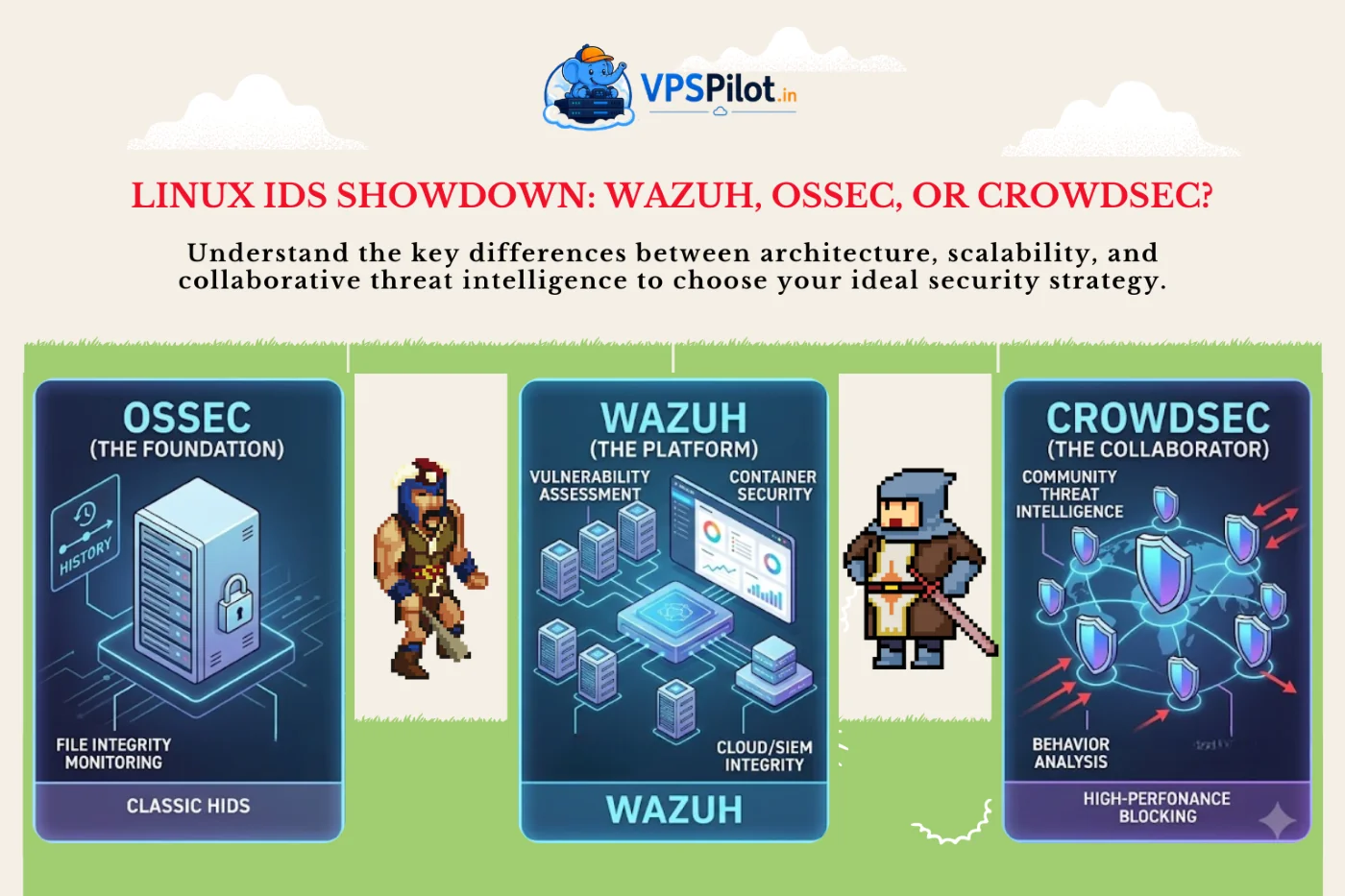
Securing a Linux server involves more than just setting up a firewall. As threats become more sophisticated, administrators must implement robust Intrusion Detection Systems (IDS) to monitor for unauthorized access, malicious file changes, and abnormal system behavior.
When evaluating open-source tools for Linux, three names consistently rise to the top: OSSEC, Wazuh, and CrowdSec. While they all serve the purpose of enhancing security, they differ significantly in architecture, scope, and philosophy.
What is an IDS?
An Intrusion Detection System (IDS) is a security mechanism that monitors system or network activities for malicious actions or policy violations. In Linux environments, these systems generally fall into two categories:
- Host-based IDS (HIDS): Monitors an individual device (host) by inspecting system logs, file integrity, and process activity.
- Network-based IDS (NIDS): Monitors network traffic to identify suspicious communication patterns.
OSSEC vs. Wazuh vs. CrowdSec
1. OSSEC: The Foundation
OSSEC (Open Source Security) is the pioneer in the HIDS space. It has been the industry standard for over a decade.
- Core Focus: Primarily a HIDS. It excels at file integrity monitoring (FIM), rootkit detection, and real-time alerting based on log analysis.
- Architecture: Follows a traditional client-server model where an agent resides on the Linux host and sends alerts to a central manager.
- Pros: Highly stable, lightweight, and well-understood. If you need a “set it and forget it” tool for a small or medium environment, OSSEC is a reliable choice.
- Cons: Development has slowed significantly. The interface is rudimentary, and it lacks the modern integrations (like cloud-native monitoring or advanced dashboarding) that today’s hybrid infrastructures require.
2. Wazuh: The Modern Platform
Wazuh is a fork of OSSEC that has evolved into a comprehensive Security Information and Event Management (SIEM) and Extended Detection and Response (XDR) platform.
- Core Focus: It goes far beyond standard HIDS. Wazuh includes vulnerability assessment, container security, cloud environment monitoring (AWS/Azure/GCP), and regulatory compliance reporting (PCI DSS, GDPR, HIPAA).
- Architecture: It significantly expands on the OSSEC architecture by integrating an Indexer (OpenSearch) and a modern Web Dashboard (Kibana-based).
- Pros: Highly scalable and enterprise-ready. It provides a visual, searchable interface for all security logs, making it ideal for large teams that need to perform forensic investigations.
- Cons: Because it is a full-fledged platform, it is significantly more resource-intensive to manage and deploy than standard OSSEC.
3. CrowdSec: The Collaborative Outsider
CrowdSec approaches security with a “community-first” philosophy. It is designed to replace traditional tools like fail2ban but with modern, cloud-native capabilities.
- Core Focus: Real-time log analysis and automated intrusion prevention. Its standout feature is its Community-Powered Threat Intelligence. When one CrowdSec user detects an attack, the IP address can be shared (anonymously) across the community to block that attacker for everyone else.
- Architecture: Extremely lightweight and modular. It consists of a local agent that parses logs and a “bouncer” that communicates with firewalls to block threats.
- Pros: Incredible at stopping brute force attacks and scanning activity. It is much faster and more efficient at parsing massive log files than traditional IDS tools.
- Cons: It is not a complete SIEM like Wazuh. It doesn’t offer the deep vulnerability scanning or compliance reporting features that an organization might require for full-scale audits.
Side-by-Side Comparison
| Feature | OSSEC | Wazuh | CrowdSec |
|---|---|---|---|
| Primary Goal | HIDS / Log Analysis | Full SIEM / XDR | IPS / Behavior Analysis |
| Complexity | Low | High | Medium |
| Best For | Traditional HIDS | Enterprise / Compliance | Real-time threat blocking |
| Visualization | Basic / Minimal | Advanced (Dashboard) | Modern CLI / Console |
| Community Feed | No | Limited | Yes (Core Feature) |
Which one should you choose?
- Choose OSSEC if: You have a small, static environment and need a lightweight, proven tool for file integrity and basic log monitoring without the overhead of modern dashboards.
- Choose Wazuh if: You are managing a large infrastructure, need compliance reporting, require cloud/container visibility, or want a centralized SIEM to aggregate logs across your entire company.
- Choose CrowdSec if: You are primarily facing automated attacks (like brute force) and want a high-performance, modern replacement for fail2ban that benefits from community threat intelligence.
Many administrators actually combine these tools. For example, you might use CrowdSec at the edge to block brute-force attackers immediately, while using Wazuh to monitor the internal security posture and compliance state of your servers.
Building a secure Linux environment is an iterative process. Whether you start with the simplicity of CrowdSec or the enterprise power of Wazuh, the most important step is moving from manual log checks to automated, intelligent detection.