
Docker Swarm vs. Kubernetes - Which Should You Use for Small Businesses?
In the evolving landscape of container orchestration, small businesses often face a pivotal decision - how to scale their deployments without drowning in operational complexity. While Kubernetes has become the industry-standard.
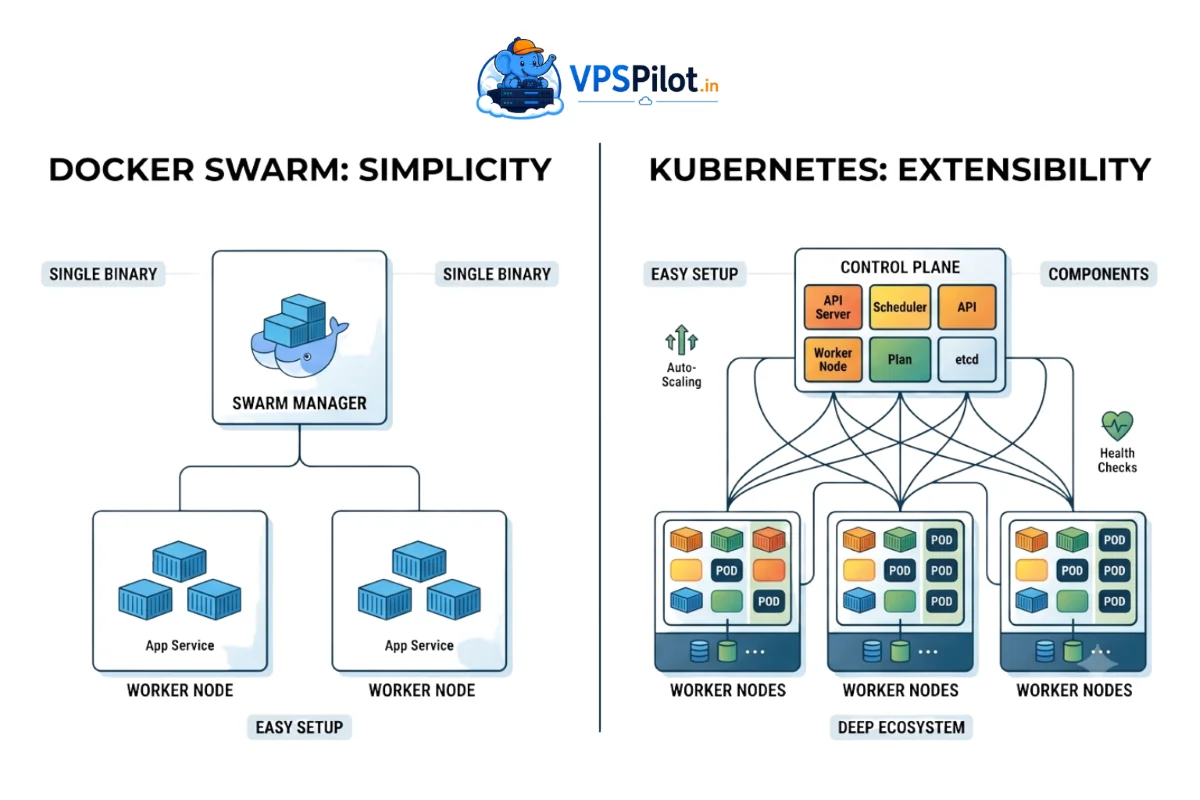
In the evolving landscape of container orchestration, small businesses often face a pivotal decision: how to scale their deployments without drowning in operational complexity. While Kubernetes has become the industry-standard “operating system for the cloud,” Docker Swarm remains a quiet, reliable workhorse for teams that prioritize simplicity.
When deciding which path to take for your deployment workflow, it is essential to weigh the immediate benefits of ease-of-use against the long-term requirements of scalability and ecosystem support.
The Core Philosophy: Simplicity vs. Extensibility
Docker Swarm: The “Developer-First” Choice
Docker Swarm is integrated directly into the Docker Engine. If your team is already comfortable with Docker Compose files, you are essentially 90% of the way to mastering Swarm.
- Best for: Small teams, internal tools, and straightforward applications where speed of deployment is the highest priority.
- Key Advantage: Near-zero learning curve. You can initialize a cluster with a single command and manage services using familiar syntax. It requires minimal administrative overhead, allowing developers to focus on features rather than infrastructure.
Kubernetes (K8s): The “Enterprise-Standard” Choice
Kubernetes is a robust, declarative system designed to manage massive clusters and complex microservice architectures.
- Best for: High-growth startups, applications with unpredictable traffic, and environments requiring strict security, compliance, or complex networking.
- Key Advantage: A massive, feature-rich ecosystem. If you need a specific tool for monitoring (Prometheus), traffic management (Istio), or continuous deployment (ArgoCD), it is almost certainly designed for Kubernetes first.
Head-to-Head Comparison
| Feature | Docker Swarm | Kubernetes |
|---|---|---|
| Setup & Learning Curve | Extremely Low | High (Steep) |
| Complexity | Low; minimal moving parts | High; complex control plane |
| Scalability | Manual; good for small clusters | Automated; designed for massive scale |
| Ecosystem | Niche; limited integrations | Massive; industry standard |
| Operational Overhead | Low; easy to self-manage | High; often requires dedicated focus |
How to Decide for Your Business
Choosing between these two isn’t just a technical decision—it is a resource allocation decision.
Choose Docker Swarm if:
- You have a small team with limited “DevOps” resources; you need to deploy quickly without hiring a dedicated infrastructure engineer.
- Your workload is predictable. If you aren’t dealing with massive traffic spikes that require auto-scaling, the simplicity of Swarm is a major asset.
- Your team is already “Docker-native.” You want to maintain a consistent developer experience from a local laptop to the production server.
Choose Kubernetes if:
- You are planning for rapid scale. If you anticipate growth that will require sophisticated auto-scaling and high availability across multiple zones, Kubernetes provides the framework you need.
- You need “best-in-class” tooling. If your business requires complex observability, security policies, and integrations with cloud-native CI/CD pipelines, Kubernetes is the only viable long-term choice.
- You have the resources. If you can afford the time and training investment to climb the steep learning curve, you will gain a future-proof platform.
The Final Verdict
For many small businesses in 2026, starting with Docker Swarm is a perfectly rational choice to get to market quickly. However, it is vital to keep your architecture clean. If you find your team spending more time “fighting the platform” to add features that Swarm doesn’t natively support, that is your signal to begin a migration to a managed Kubernetes service (like EKS, GKE, or AKS).
Managed Kubernetes platforms now abstract away much of the initial “pain” of setup, making the jump to K8s easier than it was even a few years ago.